> For the complete documentation index, see [llms.txt](https://docs.adminremix.com/llms.txt). Markdown versions of documentation pages are available by appending `.md` to page URLs; this page is available as [Markdown](https://docs.adminremix.com/help-desk/request-help/creating-a-ticket-for-others.md).
# Creating a Ticket for Others
If you have permissions that allow your to create tickets for others, here are a few ways to go about creating tickets.
## 1 - Creating a Request in the Console
Under Help Desk in the console, click on Request Help. The first prompt will ask who you are requesting help for. Once you select "for other user" the next prompt will allow you to select the user or type in the name of the user. **\*Note: User must already be in the database.**
Select "Request help for other user"
Choose the user you are requesting help for.
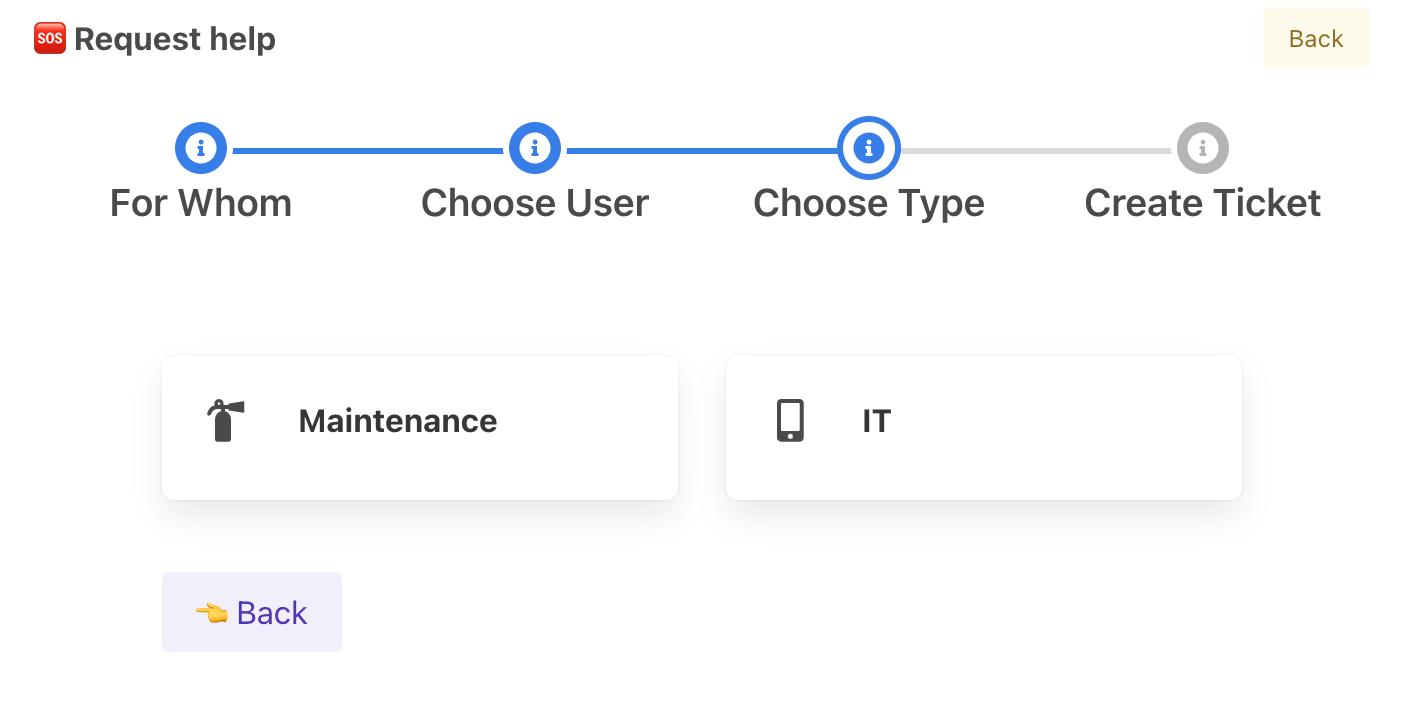
The third prompt will ask you which type of ticket you are creating. Select the ticket type from the menu and the screen will automatically move on to the last prompt. Before your ticket can be made, you will need to choose the item the ticket is being created for, and the issue for the ticket. Click submit and your ticket will be created.
The ticket will appear on the Help Desk screen once it is created. You will be able to see the details of the ticket and have editing capabilities as well.
## 2 - Creating a Ticket via Email
There could be times when an admin wants to open a ticket on behalf of another user account. In order to do this, the user with permissions will send an email to your support email \`helpdesk@\.com\` and insert a special tag in the email text of “#user:\” where “#user:” should always be used to open a ticket on behalf of an end user and following the colon should be a valid end user email address. **\*Note: You can not reply to the sending email and create a comment, doing this will create a new ticket. You can only add comments from a ticket that was sent to you from AdminRemix. These emails will look as follows “+\@inbound.adminremix.com” or you can reply to a previous email about tickets.**
If you have permissions to assign an admin to do the task you could also do so in the email, as well. Here I assigned an admin to the ticket, as well as a user. I gave an asset number, but did not use any hashtag language for the tag.
By using the # language through email, I was able to assign both the user and that admin to this ticket.
---
# Agent Instructions
This documentation is published with GitBook. GitBook is the documentation platform designed so that both humans and AI agents can read, navigate, and reason over technical content effectively. Learn more at gitbook.com.
## Querying This Documentation
If you need additional information that is not directly available in this page, you can query the documentation by asking a question.
Perform an HTTP GET request on the following URL with the `ask` and `goal` query parameters:
```
GET https://docs.adminremix.com/help-desk/request-help/creating-a-ticket-for-others.md?ask=&goal=
```
`ask` is the immediate question: it should be specific, self-contained, and written in natural language.
`goal` is what the user is ultimately trying to achieve, the reason they need the answer. Sharing it helps GitBook give you a better, more relevant answer. A goal is most helpful when it describes the outcome the user wants rather than restating the question. For example, with `ask=how do I create an API token`, a goal like `automate deployments from our CI pipeline` lets GitBook tailor the answer to that use case.
The response will contain a direct answer to the question and relevant excerpts and sources from the documentation.
Use this mechanism when the answer is not explicitly present in the current page, you need clarification or additional context, or you want to retrieve related documentation sections.